Hermès Leather Guide: Togo, Epsom, Clémence & Swift
Leather affects a bag’s appearance, feel and response to use, but a leather name alone cannot predict the experience of carrying a finished bag. Size, construction, hardware, lining, previous use and storage all matter. Color and lighting can also change how texture and wear appear in photographs.
This guide explains how to compare Togo, Epsom, Clémence and Swift without presenting uncited characteristics as fixed facts. The supplied retailer catalog records identify selected Kelly 28 bags as Togo or Epsom. They do not provide equivalent examples for Clémence or Swift, and product photographs do not independently prove leather identity, authenticity, manufacture or origin. Treat every listing as a starting point for further examination.
Togo vs Epsom vs Clémence vs Swift: what can be compared
A reliable comparison begins with evidence attached to the individual bag. Ask for the complete product record, clear condition photographs and an accurate description of any repairs or alterations. If the leather designation is important to the purchase, do not identify it from grain alone.
| Comparison point | What to check |
|---|---|
| Leather designation | The seller’s written product record and supporting documentation |
| Surface | Grain, scratches, rubbing, stains, dents and pressure marks on the actual bag |
| Shape | Front, side, base and open-top views taken on a level surface |
| Carrying weight | The complete bag, including its hardware, lining and accessories |
| Color | Images in neutral, indirect light, plus disclosure of retouching or filters |
| Corners and edges | Close-ups of abrasion, coating loss, repairs and color transfer |
| Interior | Stains, odor, pen marks, residue and structural distortion |
| Care needs | The bag’s present condition and professional recommendations |
This approach is more dependable than assuming that every item carrying the same leather name will look or age identically. Natural variation, production differences and previous ownership can affect two bags that share a catalog description.
Evaluating a bag cataloged as Togo
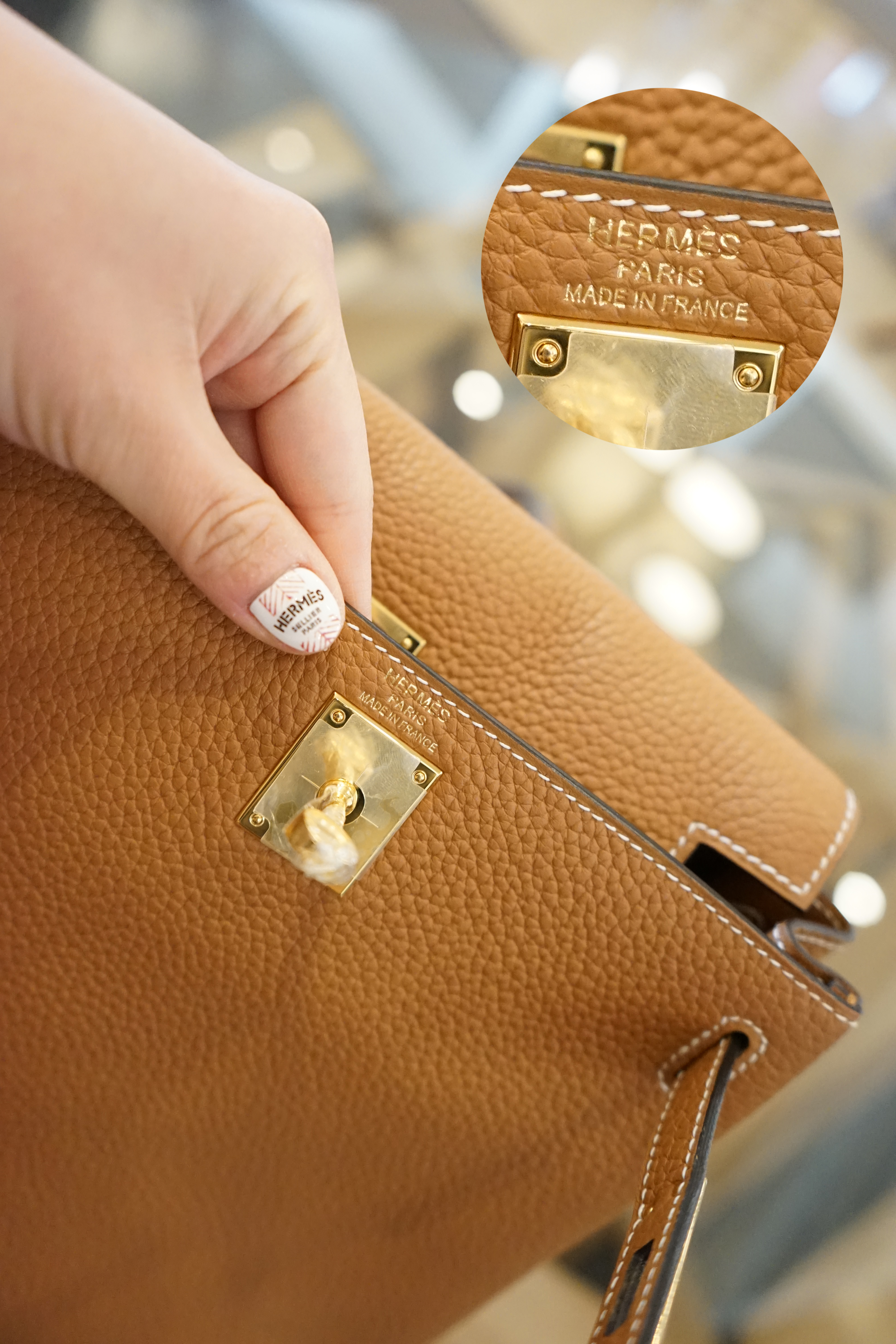
The approved retailer records include several Kelly 28 bags described as Togo leather. One example is the catalog listing for a Kelly 28 identified as Togo leather. The listing establishes how the retailer labeled that product; it should not be treated as independent authentication or as proof that any visually similar bag uses the same leather.
When reviewing a Togo-labeled bag, begin with the written designation and then examine the entire surface. Request close photographs of the front panel, back panel, base, handles, corners and areas around the hardware. Texture may look different under direct light, diffuse light or image compression, so one close-up is not enough for comparison.
Assess shape separately from texture. A bag may have softened because of storage, overfilling or regular use, but photographs cannot always reveal the cause. Side views can show whether the panels lean or bow, while an image of the empty interior can reveal whether support material is masking distortion. Ask whether the photographs show the bag empty and whether inserts are included in its stated weight.
Color also requires separate consideration. A pale Togo-labeled bag and a dark one may display handling differently even when their product descriptions use the same leather name. Inspect corners and handles closely rather than inferring condition from the main front photograph.
Evaluating a bag cataloged as Epsom
The supplied catalog also contains Kelly 28 and Jige Elan products identified by the retailer as Epsom leather. A black Kelly 28 cataloged in Epsom offers one relevant listing. As with the Togo example, its text supports only the retailer’s designation for that item.
For an Epsom-labeled bag, request photographs that show the surface at more than one angle. Regular-looking texture in a photograph is not sufficient to identify a leather, particularly when sharpening, compression and directional light can exaggerate or suppress detail. Examine flat panels and curved areas because wear may not appear equally across both.
Defined edges in a product photograph may result from the bag’s construction, condition, storage or presentation. Do not attribute the entire silhouette to leather without considering those factors. Check the base, gussets and top opening for dents, creases or asymmetry. On flap bags, inspect the fold and the areas surrounding the closure, where repeated contact may be visible.
The retailer’s white Kelly 28 cataloged in Epsom also demonstrates why color and leather should be evaluated independently. Request close-ups for grime, transfer, edge wear and previous color work whenever considering a pale bag. A bright or evenly exposed listing image does not rule out those issues.
Assessing Clémence and Swift responsibly
No approved product records supplied for this draft identify a bag as Clémence or Swift. For that reason, this guide does not assign visual, structural, weight or wear-performance claims to either leather. Those characteristics require reliable documentation beyond the available research package.
The requested historical statement that Swift was reintroduced in 2005 as the successor to Gulliver has also been omitted because no supporting source was supplied. A date-specific history should not be published until it has been checked against reliable Hermès documentation or an established specialist source.
If a seller describes a bag as Clémence or Swift, ask what supports that designation. A seller’s catalog record is useful evidence of how the item is represented, but it is not the same as independent verification. Avoid relying on general image searches, social-media captions or visual resemblance to another bag.
For either leather, use the same condition process applied to Togo- and Epsom-labeled products:
- Obtain the complete written listing and all condition disclosures.
- Review clear images of every exterior panel, corner, edge and handle.
- Examine the interior, base and areas around moving hardware.
- Ask whether the item has been cleaned, recolored, conditioned or repaired.
- Compare the complete bag’s dimensions and weight only when the seller provides them for that specific item.
- Seek qualified professional review when the designation or condition materially affects the purchase.
Compare leather and construction together
A leather comparison should never ignore construction. Two bags with different sizes, seams, linings and hardware are not controlled examples, even if their listings name different leathers. Apparent differences in rigidity or carrying weight may come from the complete design rather than the outer leather alone.
Kelly bags
For a Kelly, review front, side and top views before judging structure. Edge construction, panel alignment and the condition of the gussets affect the silhouette. Ask whether the listing identifies the construction and whether that information is documented rather than inferred from a single photograph.
The approved Togo and Epsom Kelly 28 listings can help a shopper assemble questions for the seller, but they should not be used as laboratory-style comparisons. Their colors, hardware, condition, photography and individual histories may differ.
Birkin and open-top bags
On an open-top bag, examine the rim, handles, side panels and base. Ask whether the bag was photographed with internal support. If carrying weight matters, obtain the weight of the complete empty bag rather than using a generalized leather ranking. Confirm whether the stated figure includes a lock, keys, clochette, strap or removable organizer.
Flap bags and clutches
Repeated contact may concentrate around a flap, closure and corners. Inspect those areas at high resolution and request additional images if reflections hide the surface. The approved catalog includes Epsom-labeled Jige Elan clutches, but those listings do not establish that every flap bag was made in that leather or that the material will perform identically across designs.
Relaxed or curved designs
For bags designed with curved panels, judge whether the present shape is intentional, use-related or caused by storage. Compare the bag with documented examples of the same model, size and construction rather than with a different design. Confirm the specific product’s leather instead of assuming it from its silhouette.
Choosing a leather for everyday use
There is no universally best Hermès leather for everyday use. The practical choice depends on the condition of the individual bag and the buyer’s priorities. Create a short checklist before comparing listings:
- How much visible wear are you willing to accept?
- Must the bag maintain a particular silhouette?
- Will you carry heavy or irregular objects?
- Are you comfortable monitoring a pale color for transfer or grime?
- Can you inspect the item in person or obtain detailed photographs?
- Is the leather designation documented clearly enough for your purpose?
- Has the bag received repairs, recoloring or other treatment?
Do not let a favorable leather reputation override visible condition. Existing corner abrasion, staining, odor, dents, cracking, misshaping or undisclosed repairs are immediate concerns. A well-documented bag in acceptable condition may be a better choice than one carrying a preferred leather label but supported by incomplete records.
If possible, handle the complete bag with an amount similar to what you normally carry. This is the most direct way to judge comfort, access and balance. When buying remotely, request the empty weight and clarify exactly what was included in the measurement.
Care and storage
Hermès provides official leather-care instructions and directs owners toward appropriate after-sales assistance. Because care can depend on the object and its condition, consult the current official guidance before applying any product or attempting a repair.
Conservative preventive practices include protecting the bag from moisture, excessive heat, prolonged sunlight and substances that may stain it. Avoid overfilling or forcing the bag into an unnatural shape. Store it in a dry, temperate area and use support that does not stretch the panels. Do not apply waterproofing sprays, wipes, polish or conditioner unless the treatment has been approved for the specific item.
If moisture, staining or structural damage occurs, avoid aggressive rubbing, direct heat and improvised cleaning methods. Record the issue with photographs and seek qualified advice. A treatment that changes color, texture or finish can complicate later condition assessment.
The safest comparison of Togo, Epsom, Clémence and Swift is therefore an item-by-item process. Confirm the seller’s designation, inspect the complete bag, separate color and construction from assumptions about leather, and base care decisions on current professional guidance.